


Surface imprint of a solar flare
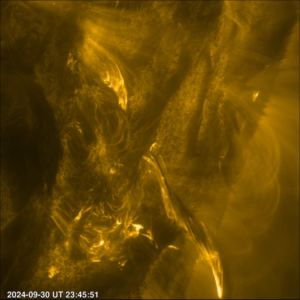
While Solar Orbiter’s Extreme Ultraviolet Imager studied the roiling magnetic fields of the 30 September 2024 solar flare up close, the Polarimetric and Helioseismic Imager (PHI) instrument observed the wider-field imprint of the flare on the Sun’s visible surface (photosphere) in impressive detail, completing the three-dimensional picture of the flare.
The video provides both imagery (left) and a ‘running difference’ sequence (right) to better highlight changes.
The two white arrows point to the imprints of some of the raining plasma blob ‘ribbons’, showing the effect of the flare right through the solar atmosphere.
Solar Orbiter is a space mission of international collaboration between ESA and NASA, operated by ESA. The Polarimetric and Helioseismic Imager (PHI) instrument is led by the Max Planck Institute for Solar System Research (MPS), Germany.
[Image description: The image is split into two square panels, side by side, both shown in bright green tones. The left panel shows a surface with a mottled texture with a dark patch near the centre-left. The dark area looks irregular and elongated, like several small shadows clustered together. The surrounding region is lighter green, with faint streaks and uneven graininess. A timestamp in white text appears in the bottom left corner showing the date '2024–09–30 UT' and a changing time. The right panel shows a uniformly speckled pattern with no large dark areas. It looks like a dense field of tiny dots and ripples in different shades of green, giving a slightly noisy, textured appearance. There are no labels or markers here.]

Solar flare seen by Solar Orbiter

Small-scale magnetism leads to large-scale solar atmosphere

Solar flare seen by EUI and STIX
Unleashing a solar flare
